Selected work
Four decisions, with the numbers.
Each one: the context, what I did, what happened, and the limits of the evidence. Client names stay off the numbers.
From volume complaints to delivery well above contract
Context
I own customer success and client delivery for the Regional Exchanges vertical of a blockchain attribution-data business: three client delivery leads and a contributor network of 43 across 25+ countries. Before I joined, clients had complained about volume.
What I did
Set an SLA per client that escalates at 66% and 85% of the window, and again at breach. Put a weekly delivery meeting and 1:1s with the leads in place. Ran the hiring pipeline across 25+ countries and wrote the screening assessment researchers are hired against. Moved parts of the network from hourly to per-unit pricing, with cost-versus-output tracking so the margin is visible.
Built the payout pipeline and the helper chat bot the network runs on, with the engineering team. I am the named account lead for one client and delivery owner across three more, and I write every client progress report myself.
Result
August 2026 closed at about 275 entities against a contract floor of 200, with over 1,200 traces: 35 to 50% more than the contract requires, month after month. Year to date: 1,072 traces and 255 entities for one client, 541 entities under management for another, and about 13 days average turnaround.
Evidence and limits
Figures from the vertical’s own delivery records, stated at role level. Client names, contract terms and breach counts stay private. Full decision record to follow.
Three consoles that took the vertical off Google Sheets
Where it started
The vertical ran on a shared Google workbook and Apps Script: contractor sheets, four client sheets, two schemas and two date formats, with scripts stitching them together.
Why it had to go
- Apps Script quotas, timeouts and slow runs as volume grew.
- No per-client isolation: one workbook could not keep client data and freelancer access apart.
- Manual copying between sheets, broken formulas, two schemas and two date formats.
- No audit trail of who changed what, and freelancers lost in tabs. Nothing was built for the job.
What I built
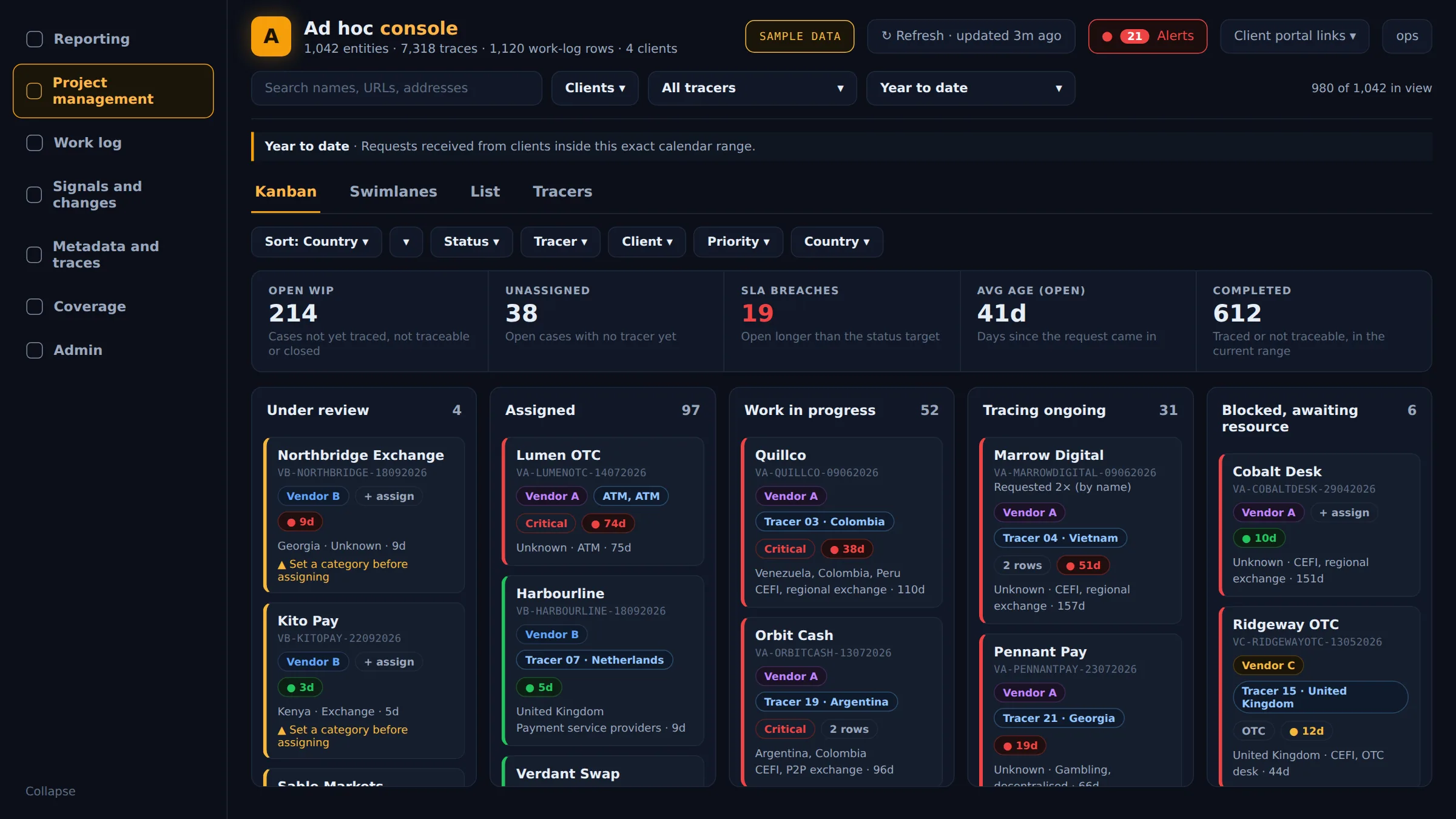
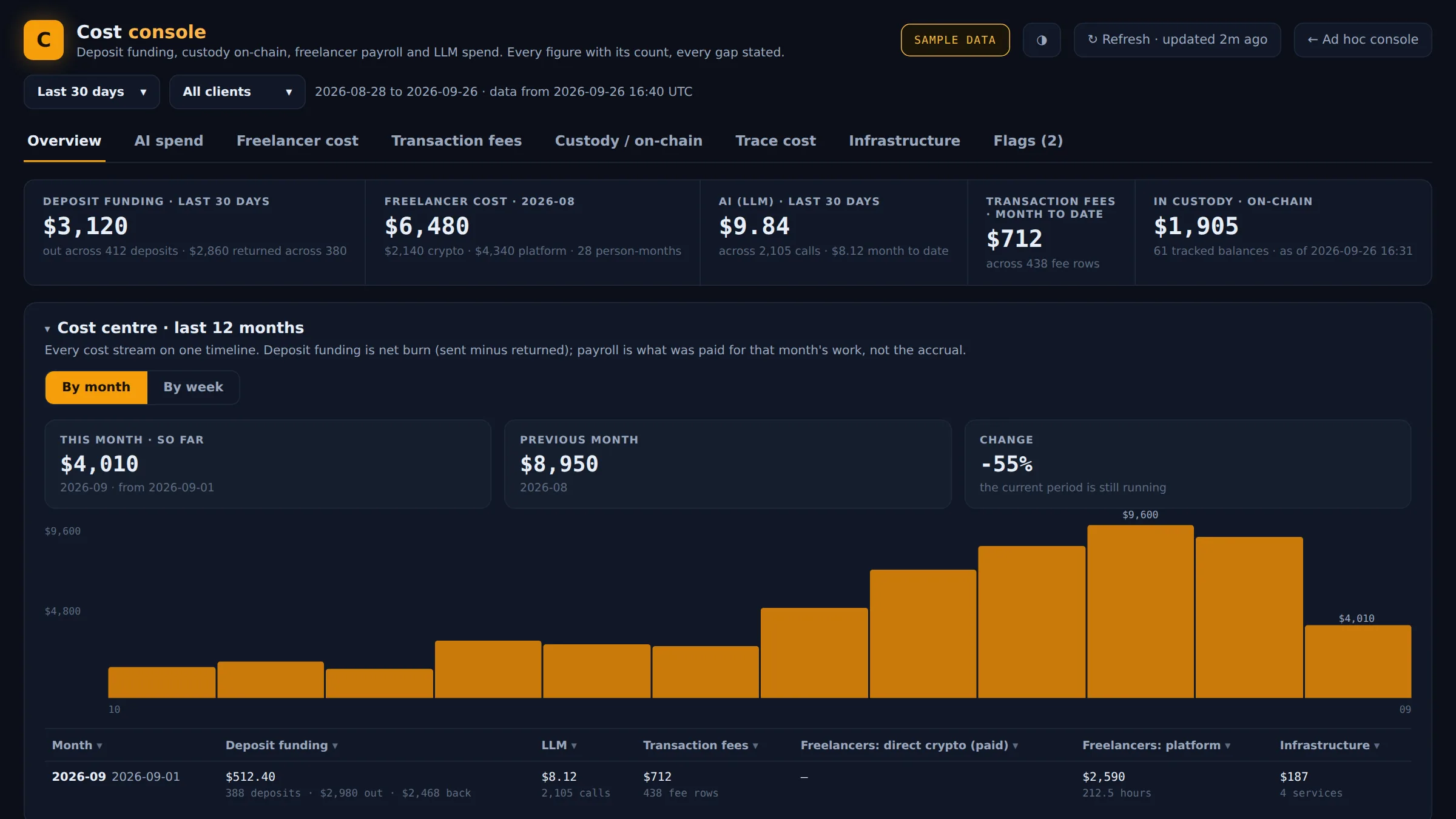
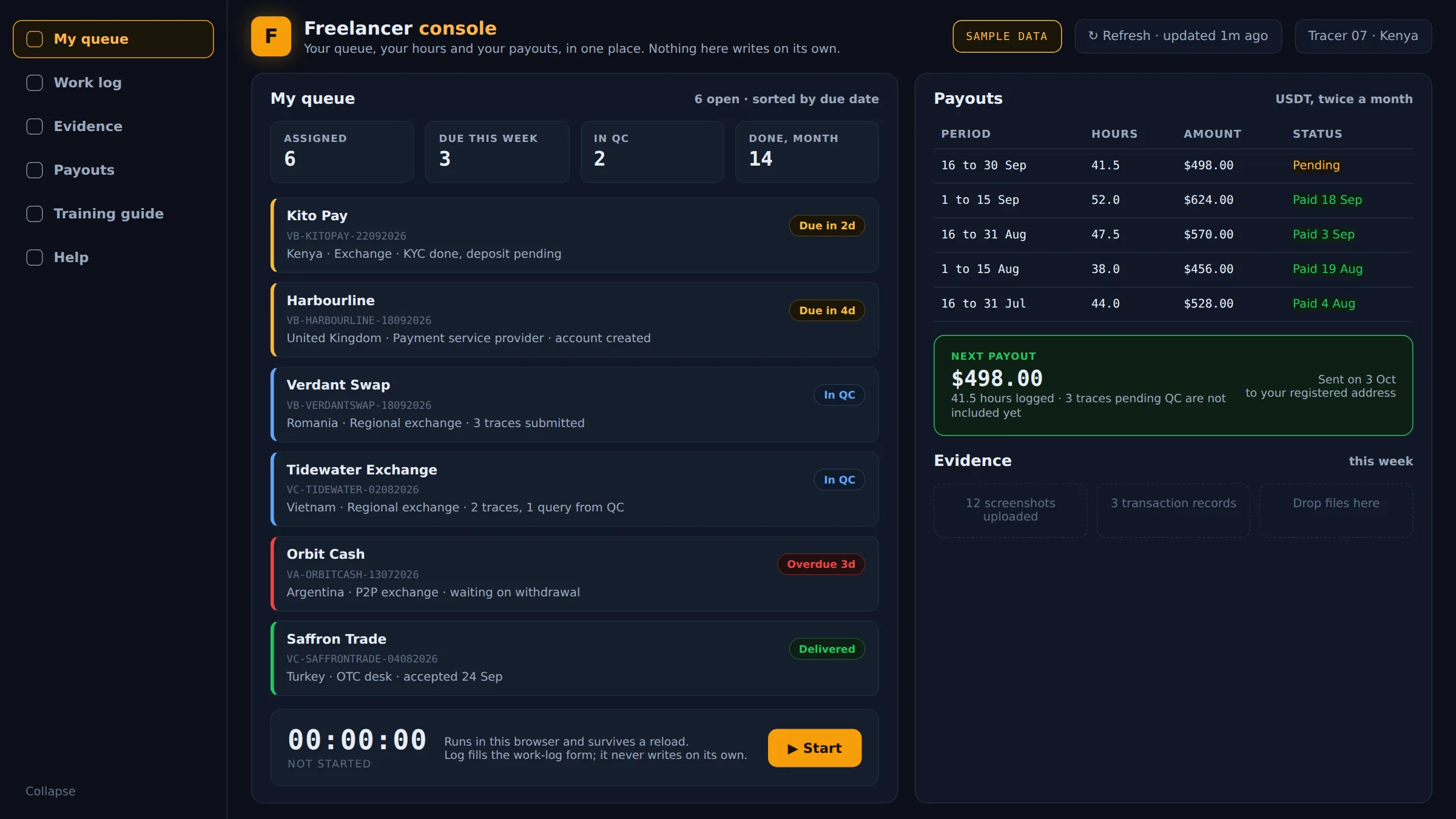
Three consoles on Supabase, Postgres and Node, each designed around the job of the person using it, shipped through the same reviewed pull-request workflow as the rest of the team.
Result
Delivery leads triage and assign from one intake. Costs sit against output per person and per client, so the margin is visible. Each of the 43 contributors works from their own queue and sees their own payout history. Client data stays isolated per client.
Evidence and limits
Internal systems, described at role level; the console views are rebuilt with sample data, not screenshots. The migration off Apps Script is still going, in reviewed pull requests. Full decision record to follow.
Grants operations for 500+ organisations
Context
I joined at the Foundation’s launch to build the grants programmes: Seed Grants (up to $25K), Growth Grants (up to $1M), the Propulsion Program with avnu, and the developer programmes. All of them are still open.
What I did
Onboarded over 500 teams, from seed-stage one-developer projects to established organisations, through grants and technical advice. My part was operational: contract management, finance distribution, and connecting teams with the right stakeholders and tools.
Designed the Foundation’s first AML/KYB framework and integrated Sumsub behind it, aligning compliance, legal and finance requirements across the US, UK and EU. Legal set the bar; we built the operational layer to meet it. Built the grant KPIs and OKRs.
Moved the grants backend from Monday.com to Airtable, and made grant payments on-chain. Covered the DevOps and security function too: access reviews across tools and wallets, secrets and multisig signer management, security checks on vendors and grantees, and incident response.
Result
Onboarding and reporting cycle times down 33% through Notion and Airtable process work. The programmes are still running: starknet-ecosystem.com/grants.
Evidence and limits
I am not a compliance officer or a lawyer: I built and ran the operation, with legal sign-off. Written up in public as ops-case-studies, case 01.
First operations hire in the UK, then Asana Champion
Context
I joined Parity, the company behind Polkadot, as its first operations hire in the UK.
Year one
Set up the London office: procurement, vendor selection, security and documentation. Ran onboarding for the entire UK division with legal, security, HR and finance, and rebuilt the onboarding and offboarding SOPs across all four.
Year two
Promoted to Operations Project Manager about a year in, once the office onboarding was set up, and moved to improving processes, systems and tools with Asana as the backbone. As Asana Champion I drove adoption, trained teams, audited their workspaces day to day and tightened how each one ran its projects.
Centralised 150+ subscriptions, €3M in annual billings, into Asana. Worked with the General Counsel, Chief Security Officer and COO to centralise procurement and run the Bug Bounty Program, with payouts in fiat and DOT and audit-ready documentation.
Alongside that, DevOps and security operations with the security team: access and devices for joiners, movers and leavers, security review of tools and vendors before procurement, and office and device security with its policies and documentation.
How it ended
Parity moved its go-to-market functions out to teams in the Polkadot ecosystem (The Block, 12 October 2023). I stayed through the transition, then co-founded chain.giving with former colleagues. The subscriptions work is ops-case-studies, case 02.